









































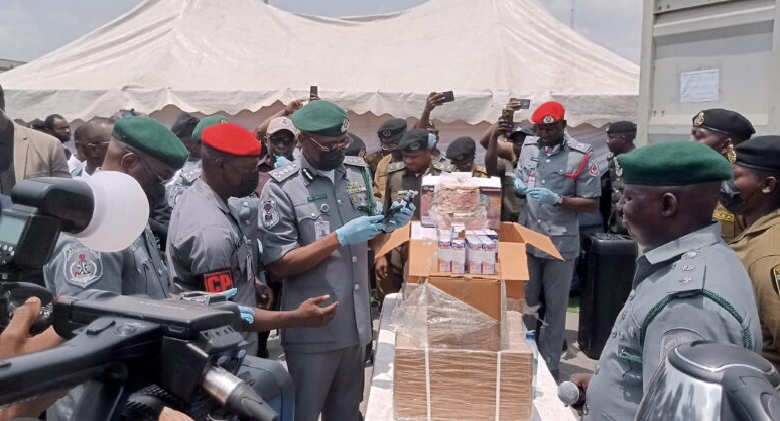
The Nigeria Customs Service (NCS) on Tuesday announced seizures of 13 containers of expired pharmaceutical products, and cannabis sativa ( Colorado) with duty paid value of N6.3billion, at Apapa port.
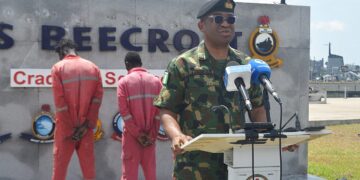
The Comptroller General, Bashir Adewale Adeniyi, MFR, told newsmen in Lagos that the seizures were a result of “ direct outcome of this shift toward intelligence-driven enforcement supported by scanning technology and targeted physical examination.”

Adeniyi disclosed that through careful risk profiling and non-intrusive inspection procedures, operatives of the Command were able to identify several containers with irregular cargo profiles that led further examination and seizure.
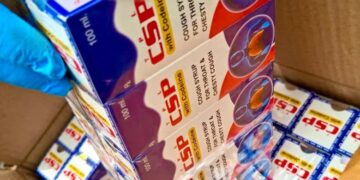
The 13 containers and additional contraband items, according to him include: “a. A 40-foot container (HASU 4072659) conveying large quantities of expired pharmaceutical products including Mixagrip Cold Caplets, Ladinax tablets, Chloroquine injections and Diclofenac tablets. (b. Two 40-foot containers (MRSU 4584911 and MRSU 6913370) conveying large consignments of Hyegra 200 and Sildenafil Citrate unregistered pharmaceuticals. (c. A 20-foot container (MRKU 8830266) conveying 800 cartons of Codeine (TPL CSC) deliberately concealed inside toilet flushing cisterns and sanitary ware. (d. A 40-foot container (MRSU 5147562) conveying cartons of Artesunate 60 injections. (e. A 20-foot container (PCIU 286888) conveying restricted security equipment without End User Certificates, including bulletproof vests, helmets, walkie-talkies and tactical torches.”
Others were “(a. A 20-foot container (TCLU 3819607) conveying expired muffin cookie biscuits. (b. A 20-foot container (UGMU 8692902) containing 36,000 cans of expired Primo energy drinks. (c. A 20-foot container (SUDU 1696593) loaded with expired St. Kelvin tomato paste. (d. Another 20-foot container (TCLU 1923314) containing expired De Truth tomato paste. (e. A 40-foot container (TCNU 7257465) containing 1,700 cartons of Codeine cough syrup concealed with luxury food flasks.
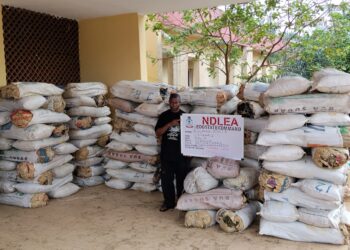
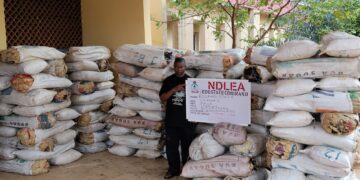
He said additional “40-foot container (CAAU 8375050) was found to contain 1,575 cartons of CSMIX with codeine concealed with 156 cartons of electric kettles, alongside additional pharmaceutical seizures including 13 cartons of Bristol brand Co-codamol 500mg and 2 cartons of Zevita brand Co-codamol 500mg. Officers also intercepted 13 jumbo bags of Cannabis Sativa (Colorado) weighing 347.57kg concealed inside a Toyota Sienna vehicle with Chassis No. 5TDDK3DC7DS057669. These seizures amount to ₦6,381,237,988.00 (Six Billion, Three Hundred and Eighty-One Million, Two Hundred and Thirty-Seven Thousand, Nine Hundred and Eighty-Eight Naira) worth of prohibited, expired and falsely declared goods.”
The CGC said that the importation of expired drugs and controlled substances remains a direct threat to public health, adding that the “concealment of codeine-based products represents a calculated attempt to fuel substance abuse and undermine our healthcare system.
He maintained that Apapa Port is no go area for smugglers or criminal syndicates hiding behind legitimate trade documentation.
Adeniyi disclosed that the Service has been working closely with government agencies and industry stakeholders to check the issue of port congestion.
He disclosed that the recent launch of the Green Channel at Lekki Deep Seaport was part of the broader strategy to accelerate cargo clearance for compliant traders and strengthen enforcement against high-risk consignments.
He added that the increasing volume of trade passing through Nigerian ports has made the responsibility of the Nigeria Customs Service even greater.
“Thousands of containers pass through this port every day carrying goods that support businesses, sustain industries and drive our national economy. While their mandate requires them to facilitate legitimate trade, they must also ensure that our ports are not exploited by criminal networks attempting to introduce dangerous, prohibited or falsely declared goods into the country,” he said.
He said that following this, the Service has deployed technology-driven enforcement tools to facilitate cargo examination and ensure efficiency at the ports.
Adeniyi added, “These systems enable officers to examine containerized cargo rapidly, detect anomalies in declarations and identify suspicious consignments without unnecessarily disrupting legitimate trade flows.
Current operational data from Apapa Port shows that 3,236 consignments were processed through the Orange channel (Non-Intrusive Inspection – scanning), 5,490 through the Yellow channel (documentary checks), while a significantly higher 21,373 consignments were subjected to full physical examination under the Red channel. Additionally, 1,118 consignments passed through the Blue channel and 149 through the Green channel, reflecting varying levels of facilitation based on compliance and risk profiling.
“This distribution clearly indicates that physical examination still dominates cargo control procedures, reinforcing the need to expand the use of scanning technology. Strengthening non-intrusive inspection and combining it with intelligence-driven risk management, will enable the Service concentrate physical examinations on high-risk shipments and facilitate fast clearance for compliant traders. Their strategic objective is therefore to significantly increase the proportion of cargo subjected to scanning across all major entry points in Nigeria before the end of the year, including Apapa, Tin Can Island, Port Harcourt, Onne, Calabar and other operational commands.
“This shift will enhance enforcement accuracy, reduce port congestion and support their broader goal of facilitating legitimate trade while maintaining robust border control. It is important to emphasize that achieving this target will depend largely on the level of compliance demonstrated by traders and other stakeholders within the port ecosystem.
“As compliance improves, Customs will be able to rely more on technology-driven inspection and risk management rather than time-consuming physical examination. This is why they strongly encourage traders to continue improving their compliance culture and take advantage of the Authorised Economic Operator (AEO) programme, which provides trusted traders with predictable clearance processes and faster cargo facilitation.”
Meanwhile, the CGC commissioned a Data Analytics Centre and inspected the newly installed Drive -Through Scanner at the Apapa Port.
He also inspected the new Drive Through Scanner at Apapa Port. He described the role of data in modern Customs administration as the real currency of international business and a critical tool for effective communication.
The CGC described credible data as the backbone of the Service’s risk management architecture.